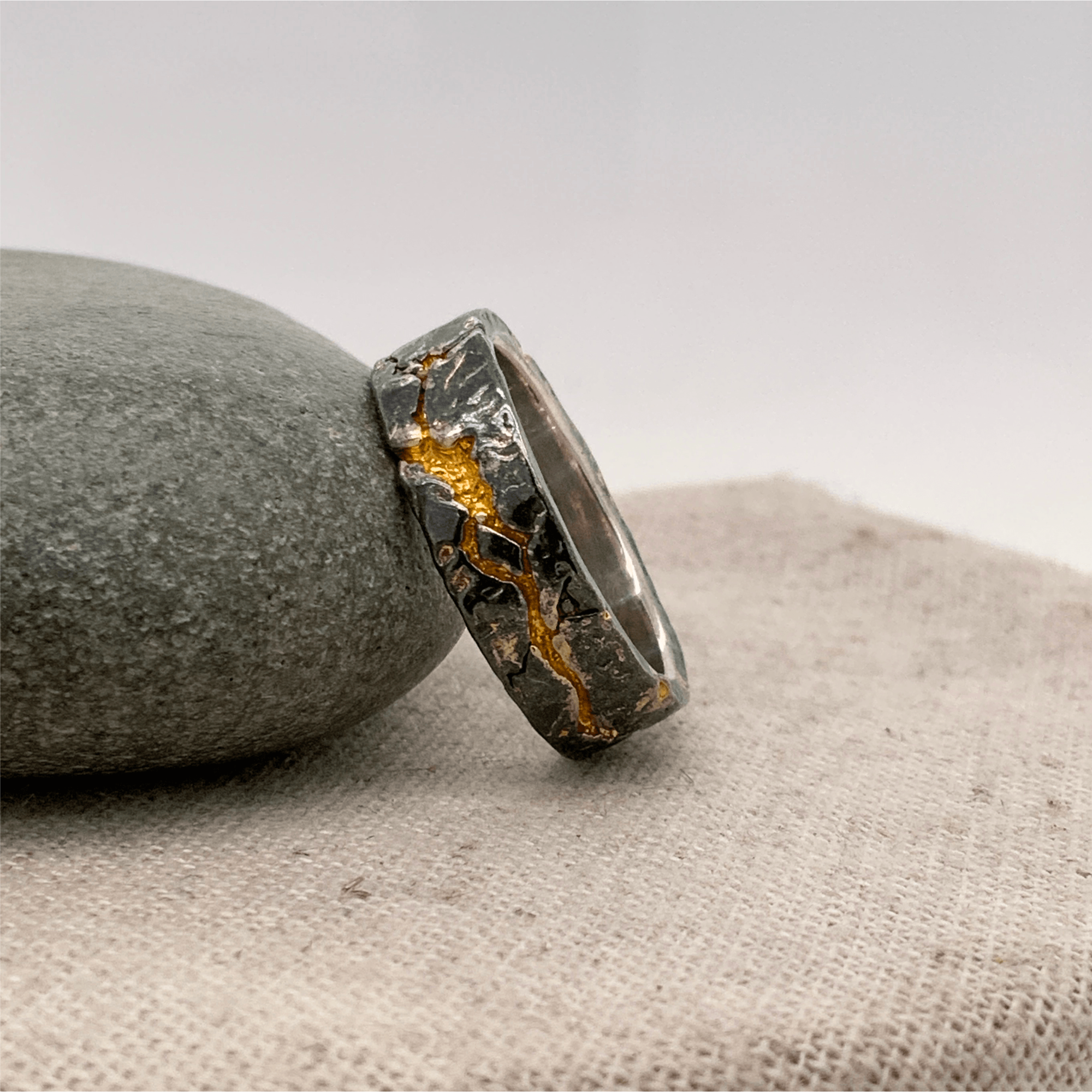
When I first started working with kintsugi-inspired rings, it wasn’t just the visual contrast of metal and “fracture” that drew me in. It was the story behind it: an old Japanese practice of mending broken ceramics with precious metals, turning the crack itself into the most beautiful part of the piece.
Kintsugi comes from the philosophy of wabi-sabi—the appreciation of things that are imperfect, impermanent, and incomplete. Instead of hiding flaws, wabi-sabi invites us to see them as evidence of life, time, and experience. In my studio, that philosophy lives inside each kintsugi ring I make.
What is wabi-sabi?
Wabi-sabi is often described as the beauty of imperfection, but it goes a little deeper than that. It’s an acceptance that everything changes, everything ages, and nothing is truly “perfect” in the polished, modern sense.
In Japanese ceramics, that might mean a bowl that’s slightly asymmetrical, a glaze that runs, or a surface that shows subtle marks from the firing. These details aren’t defects—they’re the soul of the piece.
My kintsugi rings carry that same idea. The “fractures” in the designs are deliberate, but they stand in for the real cracks we’ve all lived through: grief, loss, change, and the quiet, private repairs we make along the way.
Kintsugi rings as wearable philosophy
On my Etsy shop, I’ve created a small collection of kintsugi-inspired rings that borrow from this tradition and translate it into jewelry you can wear every day.
You can see some of them here:
Kintsugi-inspired stacking ring: Kintsugi Ring – Etsy Listing
Kintsugi band with fracture pattern: Kintsugi Band – Etsy Listing
Mixed-metal kintsugi-style ring: Mixed Metal Kintsugi Ring – Etsy Listing
Each piece is designed around a “crack” line—sometimes bold and graphic, sometimes subtle and organic. The line may be represented in a different metal, a carved channel, or a contrasting surface that catches the light. Instead of aiming for a flawless, uniform band, I’m intentionally building in the idea that something has happened to this ring—and that it’s better because of it.
We are all a little broken
One reason kintsugi resonates with so many people is that it doesn’t pretend things never broke. It acknowledges that the break happened and honors the repair.
We all carry cracks: stories we don’t tell often, losses that reshaped us, mistakes that forced us to grow. We learn to live with them, we patch ourselves together, and eventually, those “repairs” become part of who we are.
These rings aren’t about pretending everything is fine. They’re about saying:
Yes, something broke.
Yes, it left a mark.
And yes, I’m still here—and there is beauty in that.
When you wear a kintsugi ring, it can be a quiet reminder that your own fractures are not failures. They are evidence of a life lived fully and honestly. The parts of you that have been broken and mended are not the parts to hide; they’re exactly where the light catches.
Handmade, one ring at a time
Every kintsugi-inspired ring I make is handcrafted in my studio—shaped, formed, and finished by hand. The “fracture” lines are not stamped from a template; they’re drawn into the design, so each ring has its own individual character.
Because of that, no two pieces are ever exactly the same. Some rings have a more subtle, delicate pattern, while others lean into a bold, high-contrast look. You can stack them with other bands, wear one as a statement, or choose a wider ring that feels like a small piece of art on your hand.
You can browse the current designs here:
Kintsugi collection on Etsy – Alari Jewelry
A ring as a reminder
I’ve heard from people who choose a kintsugi ring to mark a turning point—a recovery, a loss they’ve learned to live with, a new chapter after a difficult season. Others simply feel drawn to the visual language of cracks and gold, and only later realize how much it mirrors their own story.
However you come to it, my hope is that wearing one of these rings feels like a small act of honesty and self-kindness. You don’t have to be “perfect” to be worthy of something beautiful. In fact, that’s the point.
We’re all a little broken. We’re all a little repaired. And sometimes, the most meaningful jewelry is the kind that quietly says: I’ve been through something—and I’m still here.